


As we explore the landscape of the insurance industry, it is crucial to understand how 5 Ways Agentic AI Is Transforming Insurance are reshaping traditional underwriting processes and enhancing efficiency.
Insurance underwriting is entering a new operating paradigm. For decades, the function has relied on manual data gathering, static rule sets, and human judgment applied to fragmented information. That model is breaking down under the weight of rising submission volumes, softening rates, and carrier demands for faster, more accurate risk decisions. Agentic AI in insurance underwriting represents the structural response—autonomous multi-agent systems that can reason, decide, and execute across complex workflows with minimal human direction.
The data confirms the shift is underway. The Evident AI Use Case Tracker reports that insurance AI deployments grew 87% year-over-year, with agentic AI accounting for one in five public deployments in Q4 2025. WTW’s March 2026 Advanced Analytics & AI Survey found that insurers using sophisticated analytics achieved combined ratios six percentage points lower and premium growth three percentage points higher than slower adopters. Yet only 16% of P&C insurers currently use AI to augment human underwriting, even as 60% plan to prioritize it by 2028.
The gap between intent and execution defines the competitive landscape for 2026. The five transformations below are not theoretical—they are happening now, at carriers that have moved past pilots into production.
Click here: ITT hub article on top 10 insurance technology trends redefining the market in 2026
1. Autonomous Submission Triage Replaces Manual Intake
The underwriting bottleneck begins at intake. Brokers submit applications through emails, PDFs, spreadsheets, and ACORD forms—each in different formats, with varying levels of completeness. McKinsey estimates that underwriters spend 30–40% of their time on administrative tasks like rekeying data from submissions. In a softening market where speed to quote determines whether a carrier wins the business, that administrative overhead is a direct competitive liability.
Agentic AI systems are eliminating this bottleneck by deploying specialized intake agents that can extract data from unstructured broker submissions, verify information against internal and third-party datasets, identify missing fields, and proactively communicate with brokers to resolve gaps—all without underwriter intervention. The agent then triages each submission based on risk appetite, potential profitability, and complexity, routing straightforward cases for automated quoting and escalating complex risks to human underwriters.
The impact is measurable. According to industry analysis, agentic underwriting platforms are processing submissions that previously took hours of manual review in minutes. Carriers deploying these systems report that underwriters can redirect the recovered time toward complex risk assessment, relationship building, and strategic portfolio decisions—the work where human judgment creates the most value.
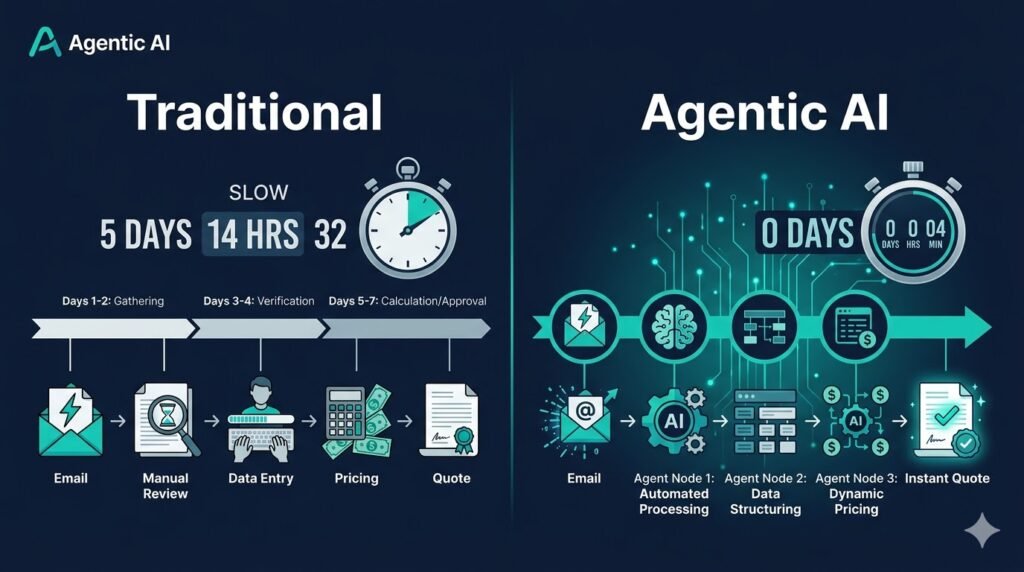
2. Quote-to-Bind Cycle Times Compress by Up to 99%
Speed is the currency of underwriting in 2026. In a softening market where brokers can place business with multiple carriers simultaneously, the insurer that responds fastest with an accurate quote wins disproportionate share. Agentic AI is compressing this timeline from days to minutes.
The most striking documented result comes from Hiscox, which achieved a 99.4% reduction in quote cycle time for London Market specialty lines—compressing turnaround from three days to approximately three minutes while preserving underwriter control over final pricing. This is not a pilot metric. It is a production result from a major specialty insurer in one of the world’s most complex commercial markets.
Industry benchmarks from hyperexponential show that commercial P&C insurers implementing agentic AI systems are achieving quote-to-bind reductions of 60–99% across various lines. A DXC benchmark study projects that underwriting processes overall can be cut by up to 75% through scaled agentic deployment. The competitive dynamic is straightforward: carriers operating at three-minute response times will consistently outcompete carriers operating at three-day response times for the same risk.
3. Loss Ratios Improve 3–5 Points Through Dynamic Risk Assessment
Faster quoting means nothing if the underwriting is less accurate. The critical question for any AI-augmented underwriting system is whether speed comes at the cost of risk selection quality. The emerging data answers that question decisively.
According to hyperexponential’s analysis of commercial P&C carriers, insurers implementing agentic AI systems are achieving loss ratio improvements of three to five percentage points. For a carrier with a $1 billion premium portfolio, that translates to approximately $40 million in annual underwriting profit improvement. WTW’s March 2026 survey corroborates the pattern: insurers using more sophisticated analytics achieved combined ratios six points lower than slower adopters between 2022 and 2024.
The mechanism is dynamic, continuous risk assessment. Unlike traditional underwriting, which evaluates risk at a single point in time, agentic systems ingest real-time data from IoT sensors, satellite imagery, telematics, and third-party databases to build risk profiles that update continuously. A portfolio management agent can monitor concentration risk across geography, industry, and peril type, alerting underwriters to emerging accumulations before they become problematic.
McKinsey’s July 2025 research frames the strategic significance: AI leaders in insurance have generated 6.1 times the total shareholder return of AI laggards over five years. The underwriting function—where pricing precision directly drives profitability—is the domain where that performance gap is most likely to widen.
Click here: McKinsey “The Future of AI in Insurance” report
4. Multi-Agent Architectures Create a New Underwriting Operating Model
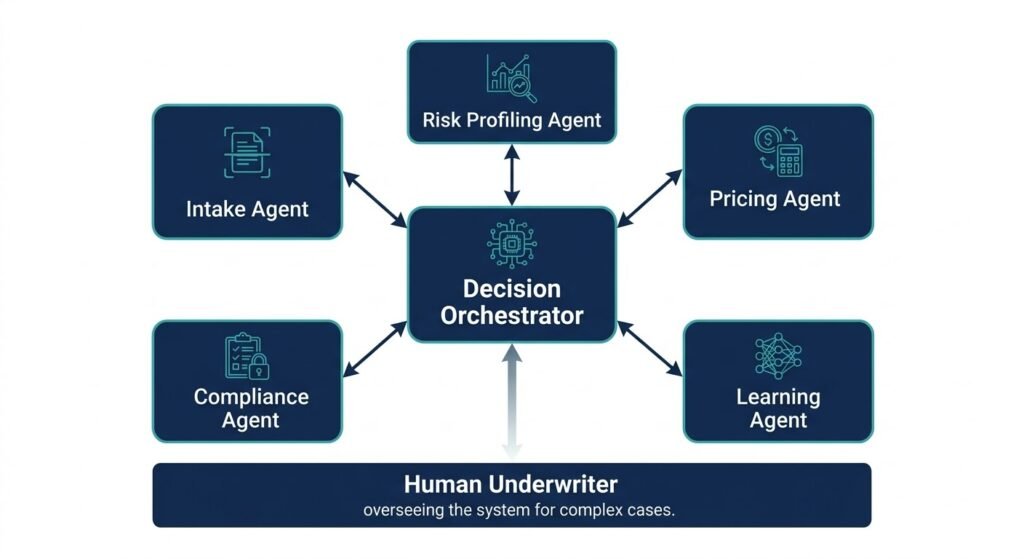
The most significant transformation is not any single AI capability—it is the architectural shift from monolithic underwriting workflows to orchestrated multi-agent systems. McKinsey describes a near-future underwriting environment where specialized agents collaborate autonomously: an intake agent ingests and clarifies submission data; a risk profiling agent builds comprehensive profiles using underwriting guidelines; a pricing and product agent structures the policy and prices the risk; a compliance agent reviews the process for regulatory adherence; and a decision orchestrator aggregates input to determine whether a case can be approved automatically or requires human escalation.
This is not speculative. Celent’s most recent gen AI survey found that 22% of insurers plan to have an agentic AI solution in production by year-end 2026. The agentic AI insurance market is projected to grow from $5.76 billion in 2025 to $7.26 billion in 2026, reflecting a 26% growth rate. Adoption is forecast to rise from approximately 14% today to 70% by 2028, according to industry projections.
The operating model implications are profound. Underwriters are not being eliminated—they are being repositioned as portfolio strategists and complex risk specialists, supported by autonomous agents that handle the volume processing, data enrichment, and routine decision-making that previously consumed the majority of their time. ITT article on essential data architecture upgrades for scaling insurance AI
5. Governance and Explainability Become the Scaling Enablers
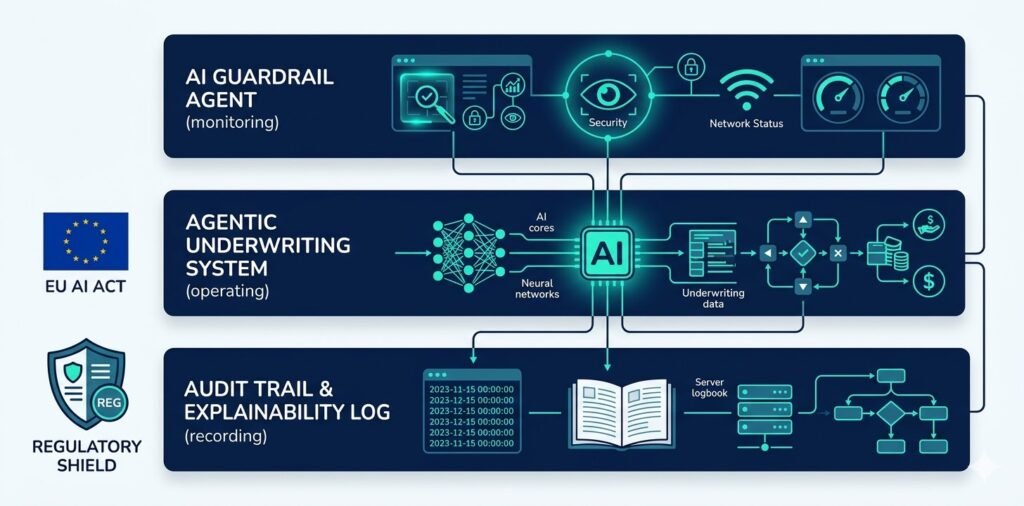
The carriers deploying agentic AI fastest are not the ones with the least governance. They are the ones with the most. Industry analysis shows that seven of the top ten agentic AI-adopting insurers scored four out of five or higher on data governance and ethics assessments. These firms are embedding AI guardrail agents—specialized systems that monitor and constrain other AI agents—to ensure responsible deployment at scale.
The regulatory landscape reinforces this dynamic. The EU AI Act, taking effect in August 2026, requires auditable documentation for AI models used in underwriting, including bias testing and decision explainability. In the U.S., state regulators are expanding their focus on AI governance and the fairness of automated rating factors. The NAIC framework recommends that large insurers disclose their approach to AI-driven risk assessment.
The practical implication is that agentic AI systems must be designed for transparency from the outset. Every automated underwriting decision needs a clear audit trail showing what data was used, which agents contributed to the decision, and why a particular risk was priced, accepted, or declined. As one industry expert at ITC Vegas summarized the challenge: AI that cannot be explained is AI that cannot be adopted.
Carriers that operationalize explainable AI governance now will deploy faster, build stronger broker trust, and face fewer regulatory obstacles than those that treat governance as an afterthought.
The Underwriting Function in 2026: Augmented, Not Replaced
The five transformations above share a common thread: agentic AI in insurance underwriting is not replacing human judgment. It is restructuring how that judgment is deployed. The administrative burden that consumed 30–40% of underwriter time is being absorbed by autonomous agents. The cycle times that once stretched across days are compressing to minutes. The risk assessment that relied on static snapshots is becoming continuous and dynamic.
The financial case is settled. Combined ratios six points lower. Loss ratios improving three to five points. Quote-to-bind times reduced by up to 99%. Underwriting expense ratios projected to decline 15–20% in P&C and more than 25% in life insurance. These are not marginal improvements. They represent a structural shift in underwriting economics.
The remaining question is not whether agentic AI will transform underwriting. It is whether your organization will be among the 22% deploying it by year-end 2026—or among the majority still catching up.
