


The hard market is ending, and the safety net of rising premiums is disappearing with it. Deloitte’s 2026 Global Insurance Outlook projects the U.S. P&C combined ratio will worsen to approximately 99% by year-end, up from 97.2% in 2024. Global life sector growth is expected to settle around 2.4%, down from its 2024 peak. For carriers that spent the last three years riding rate increases, the message is clear: profitability must now be earned through operational precision and technological leverage, not gifted by pricing cycles.
Meanwhile, the insurance technology trends reshaping the industry have reached an inflection point. Global InsurTech investment rose 19.5% to $5.08 billion in 2025, according to Gallagher Re, marking the first annual increase since 2021. Re/insurers made a record 162 private technology investments into insurtechs last year. AI-centered companies captured nearly 78% of all Q4 2025 funding. The capital has spoken, and it is flowing toward infrastructure, not experiments.
Yet a stark divide persists. According to Bain & Company, only 4% of P&C insurers have scaled generative AI enterprise-wide, while 78% remain stuck in pilot programs. McKinsey’s July 2025 research on AI in insurance found that the sector’s AI leaders have generated 6.1 times the total shareholder return of laggards over five years—the widest performance gap of any industry studied.
The following ten trends represent the forces separating the 4% from the 78%. Each is grounded in verifiable data from the leading research firms tracking this market—and each carries direct implications for how carriers, insurtechs, and investors should allocate attention and capital in the year ahead.

1. The “Pilot Trap” Snaps Shut — Only 4% of Insurers Have Scaled AI Enterprise-Wide
The experimentation phase is over. Bain & Company’s survey of 81 global P&C insurers found that while 78% are “dabbling” with generative AI in claims, only 4% have scaled it across the organization. That figure should alarm every insurance executive reading this article.
The gap between those two groups is not incremental—it is structural. McKinsey’s research shows that the 4% who have scaled AI are not simply more efficient. They are fundamentally redesigning workflows from end to end. Bain estimates that this approach can deliver roughly 35% productivity gains in claims and cut processing times approximately in half. The carriers still running isolated AI pilots are watching their competitors compound those advantages quarter after quarter.
Aviva offers a case study in what scaled deployment looks like: the UK insurer rolled out more than 80 AI models across its claims domain, reducing liability assessment time by 23 days, improving claims routing accuracy by 30%, and cutting customer complaints by 65%. The company reported savings exceeding £60 million in 2024 from claims transformation alone, according to McKinsey.
The bottom line: 2026 is the year the pilot trap becomes a sinkhole. Carriers that have not committed to full domain-level AI transformation risk permanent competitive disadvantage.
2. Agentic AI Moves From Buzzword to Underwriting Workforce
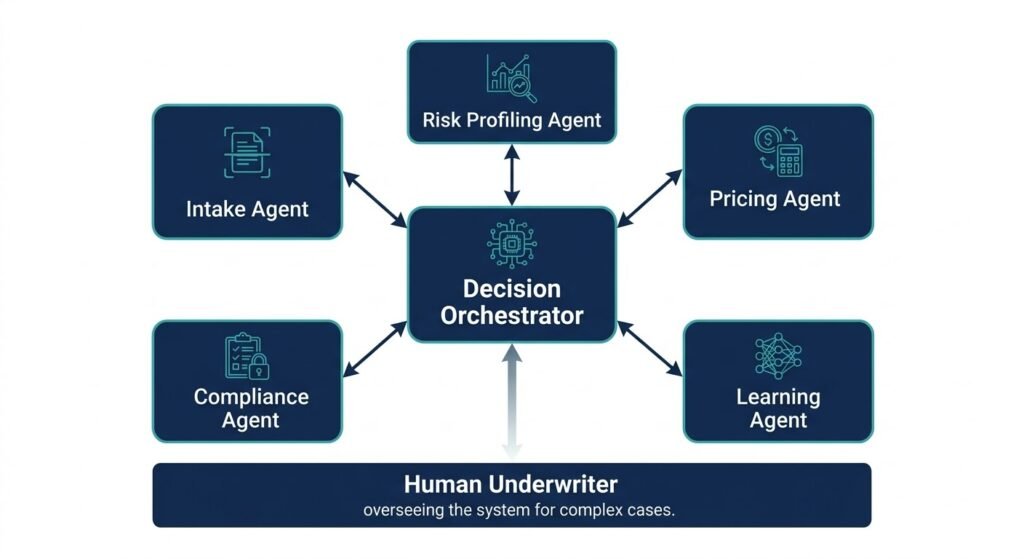
Agentic AI—autonomous multi-agent systems capable of reasoning, deciding, and executing across complex workflows—has moved from conference-stage concept to production deployment. The Evident AI Use Case Tracker reports that insurance AI use cases grew 87% year-over-year, with agentic AI now accounting for one in five public deployments among major insurers in Q4 2025.
The underwriting function is the primary beneficiary. WTW’s March 2026 Advanced Analytics & AI Survey found that while only 16% of P&C insurers currently use AI to augment human underwriting, 60% plan to prioritize it by 2028. Early movers are already reporting dramatic results: Hiscox achieved a 99.4% reduction in quote cycle time for London Market specialty lines, compressing turnaround from three days to three minutes. A DXC benchmark study projects P&C underwriting expense ratios declining 15–20% with scaled agentic deployment.
These are not incremental efficiency gains. They represent a structural shift in how underwriting capacity is generated. [INTERNAL LINK: ITT article on agentic AI transforming insurance underwriting in 2026]
3. AI-Driven Fraud Detection Targets $160 Billion in P&C Savings
Fraud detection has emerged as one of the highest-ROI, lowest-risk entry points for AI deployment across the insurance value chain. Deloitte’s 2026 Global Insurance Outlook estimates that AI-driven, real-time fraud analytics could save the P&C industry as much as $160 billion by 2032.
The adoption curve is accelerating. According to WTW’s March 2026 survey, only 33% of carriers currently use advanced analytics for claims fraud detection, but that figure is expected to reach 65–70% within the next two years. Similarly, claims severity assessment analytics are projected to more than double from 29% adoption today. The Evident AI tracker notes that around 40% of insurers now report tangible business outcomes from AI deployments, with productivity gains accounting for 77% of reported results.
The strategic implication is straightforward: fraud analytics represents a clear, board-ready AI investment with measurable financial return—and the data suggests most carriers have barely begun to capture the opportunity. Click here: Deloitte 2026 Global Insurance Outlook
4. Data Architecture Becomes the Make-or-Break Foundation for AI at Scale
Every trend on this list depends on one prerequisite: data that is clean, accessible, and governed. Deloitte’s 2026 Outlook acknowledges that many insurers continue to struggle with “fragmented, messy data sprawl and outdated systems,” calling data readiness a precondition for industrializing AI.
WTW’s March 2026 survey quantifies the challenge: 42% of P&C insurers report data-related issues—poor quality and limited accessibility—as the primary barrier to analytics adoption. Only 20% have a well-defined analytics strategy guiding daily operations, and just 12% regularly offer analytics training to employees.
McKinsey frames the stakes differently: change management represents half the effort required to secure financial impact from AI transformations. Clean data, modeling, and integration account for the other half. Carriers that fix their data architecture first will scale AI. Those that don’t will spend millions on tools that sit idle. Click here: ITT article on essential data architecture upgrades for scaling insurance AI
5. Embedded Insurance Crosses the $176 Billion Threshold
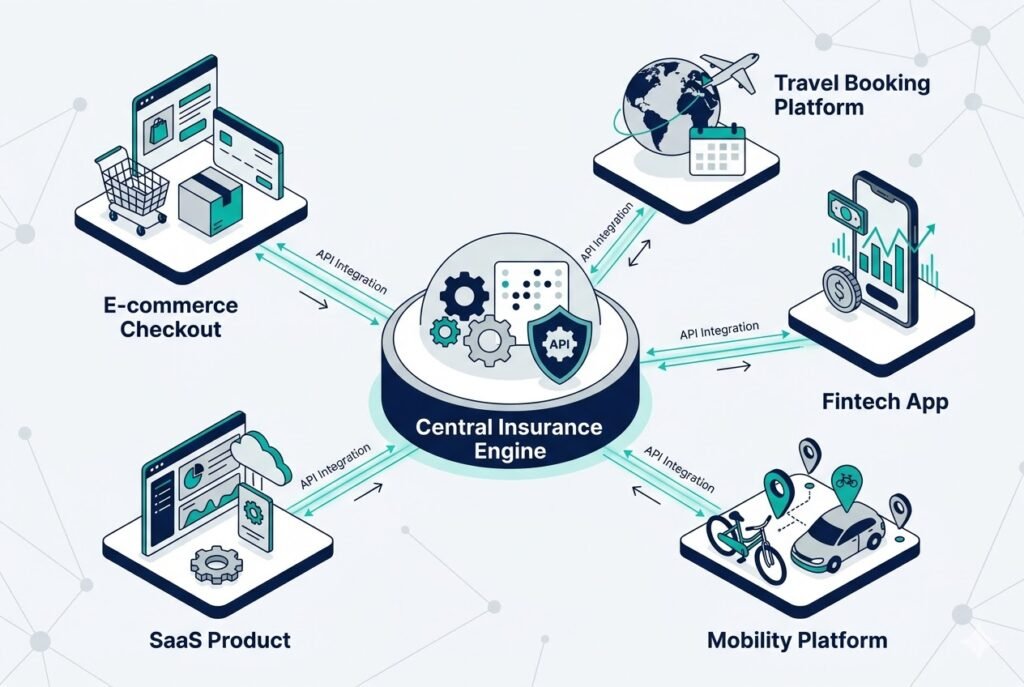
Embedded insurance—coverage integrated directly into purchase journeys for travel, e-commerce, mobility, and digital platforms—has crossed the threshold from innovation experiment to strategic distribution channel. Multiple market research firms project the global embedded insurance market between $176 billion and $189 billion in 2026, growing at a CAGR exceeding 30%.
The consumer signal is unambiguous. Capgemini’s World Life Insurance Report 2026 found that 67% of consumers under 40 want digital access paired with dedicated advisor support, yet only 16% of insurers deliver this experience today. That gap represents both a competitive threat and a distribution opportunity. Industry analysts note that embedded insurance is transitioning from a loyalty feature into a dedicated product vertical, with platforms now accountable for service quality, claims experience, and loss ratios.
API-first architectures and white-label models are the enabling infrastructure. Carriers without modular, cloud-native core systems face structural limitations in accessing this channel. Click here: ITT article on strategies for scaling embedded insurance and omni-channel CX
6. Legacy Modernization Hits the Point of No Return
The legacy modernization narrative has shifted. The story is no longer about cloud migration timelines—it is about generative AI accelerating the modernization process itself. According to Capgemini research published in early 2026, 88% of insurers have adopted hybrid cloud infrastructure. The differentiator now is whether carriers pair that technology investment with the organizational redesign that makes it productive.
McKinsey documents the acceleration: a top-15 global insurer used gen AI to achieve more than 50% improvement in code modernization efficiency and accelerated coding tasks by over 50%. Separately, a leading financial institution cut a projected $100 million-plus legacy modernization bill to less than half using gen AI tools. Celent’s gen AI survey projects approximately 80% of U.S. insurers will have implemented a gen AI-based solution by Q1 2026.
The carriers that have not started this journey face compounding technical debt. Every quarter of delay widens the infrastructure gap between them and their AI-native competitors. Click here: McKinsey “The Future of AI in Insurance” report
7. The InsurTech Funding Landscape Matures — $5.08 Billion and a New Power Structure
Gallagher Re’s Q4 2025 Global InsurTech Report confirms a structural shift in how the sector is funded. Global InsurTech investment rose 19.5% to $5.08 billion in 2025—the first annual increase since 2021. Q4 alone surged 66.8% to $1.68 billion, the largest quarterly figure since Q3 2022.
Three dynamics define this new capital environment. First, re/insurers made 162 private technology investments in 2025, more than any year on record. The industry itself—not venture capital—is now the primary funding engine. Second, AI-centered insurtechs captured 77.9% of all Q4 2025 funding across 66 deals, with an average deal size of $22.14 million. Third, deal count hit its lowest level since early 2020 (76 deals in Q3 2025) while average deal size increased, signaling a market that rewards fewer, larger, higher-conviction bets.
The message for founders: discipline, measurable ROI, and defensible underwriting or risk technology are the criteria that unlock capital in 2026. The message for carriers: the companies you are investing in today are becoming the operational infrastructure of modern insurance.
8. Parametric Insurance Scales Beyond Catastrophe Into Mainstream Commercial Lines
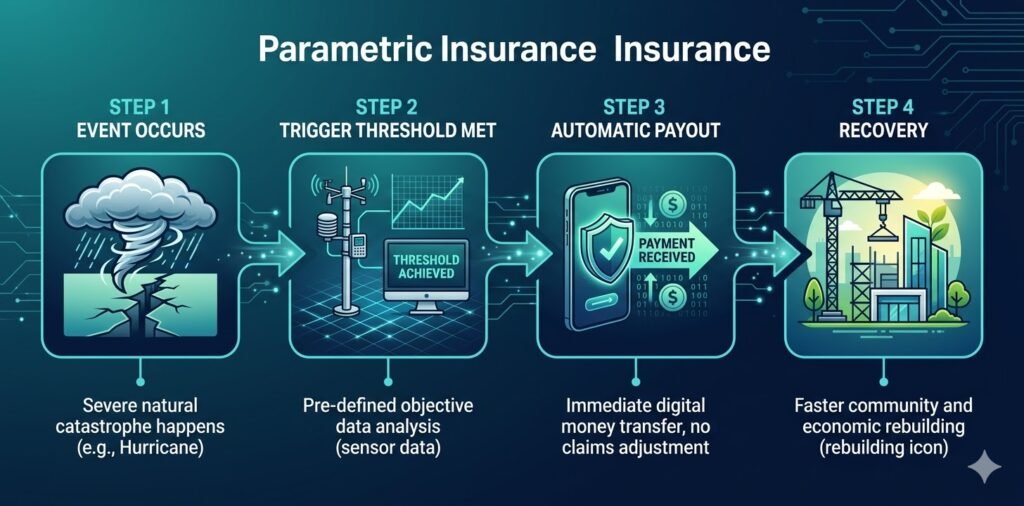
Parametric insurance—products that pay out automatically when predefined triggers are met, such as wind speed thresholds or seismic data—has moved beyond its niche in natural catastrophe coverage. Market research estimates place the global parametric market at $21–24 billion in 2026, growing at a CAGR of approximately 13%.
The expansion into new commercial lines is the critical development. Ki Insurance now tracks supply chains via GPS to trigger rapid payouts for disruption events. Parametrix paid cloud outage claims within two weeks of an Amazon Web Services incident in October 2025. Hybrid-parametric models—combining fast parametric triggers for initial payout with indemnity layers for loss adjustment—are gaining commercial momentum.
The protection gap driving this trend is massive. The Swiss Re Resilience Index estimates the global gap could top $1.8 trillion, while insured natural catastrophe losses reached $107 billion in 2025 alone. Parametric insurance was placed on the G20 agenda at a Disaster Risk Reduction Working Group meeting in November 2025, with leaders calling for a scaling-up of parametric products alongside catastrophe bonds and risk pools. Click here: ITT article on parametric insurance innovations closing the 2026 climate protection gap
9. The Workforce Equation Flips — AI Eliminates Roles and Creates New Ones Simultaneously
The workforce conversation in insurance has moved past abstract debate about AI replacing humans. Chubb announced a multi-year digital transformation plan targeting a 20% headcount reduction over three to four years while aiming to automate 85% of major underwriting and claims processes. In the same announcement, Chubb disclosed that it is expanding its global engineering hubs and now employs more than 3,500 engineers. Allianz is reportedly preparing to reduce 1,500 to 1,800 positions in its travel insurance division as a direct result of AI-driven automation.
The pattern is not elimination—it is replacement of what roles require. Deloitte’s 2026 Outlook found that 90% of insurance executives agree on the urgency of reinventing the employee value proposition to reflect human-machine collaboration, yet only 25% have taken tangible action. Industry analysts estimate approximately 400,000 U.S. insurance workers will retire by 2026. In the London Market, the proportion of the workforce aged 50 and over has risen from 17% a decade ago to 25% today.
The carriers that invest in reskilling and workforce design will outcompete those that simply cut. The talent gap is now a skills gap—and closing it is a strategic imperative, not an HR initiative.
10. Regulation Becomes a Strategic Accelerator — Not Just a Compliance Cost
The EU AI Act takes effect in August 2026, requiring auditable documentation for AI models used in underwriting or claims automation, including bias testing and decision explainability. In the UK, the Prudential Regulation Authority has scheduled its Dynamic General Insurance Stress Test for May 2026. In the U.S., the NAIC framework recommends large insurers disclose exposure to physical and transition climate risks, while state regulators are expanding their focus on AI governance and fairness of automated rating factors.
The conventional wisdom says regulation slows innovation. The 2026 data says the opposite. According to industry analysis, the most mature AI-deploying firms have the most robust governance frameworks. Seven of the top ten agentic AI-adopting insurers scored four out of five or higher on data governance and ethics assessments. These carriers are embedding AI guardrail agents to monitor and restrain other AI systems, enabling faster deployment with lower risk.
For insurance technology trends in 2026, regulation is becoming the strategic moat, not the roadblock. Carriers that operationalize compliance early will turn it into a competitive advantage through explainable decisions and disciplined pricing.
The Defining Question for 2026
These ten insurance technology trends share a common thread: the gap between leaders and laggards is no longer closing. It is widening. The 4% scaling AI enterprise-wide are compounding returns. The carriers investing in data architecture, embedded distribution, and parametric products are building structural advantages that late movers cannot easily replicate.
The defining question for every insurance executive, founder, and investor in 2026 is not whether these trends are real. The data has settled that debate. The question is whether your organization is positioned on the right side of the divide—and whether the investments you make this year will still matter in 2028.
The playbook is in the data. The time for deliberation is over.
Sources: Deloitte 2026 Global Insurance Outlook; McKinsey “The Future of AI in Insurance” (July 2025); Capgemini World Life Insurance Report 2026; WTW 2026 Advanced Analytics & AI Survey (March 2026); Gallagher Re Q4 2025 Global InsurTech Report; Evident AI Use Case Tracker Q4 2025; Swiss Re Resilience Index 2024; Bain & Company P&C AI Survey 2025; Send/Camelot “Top 10 Insurance Trends Shaping Underwriting in 2026.”
