

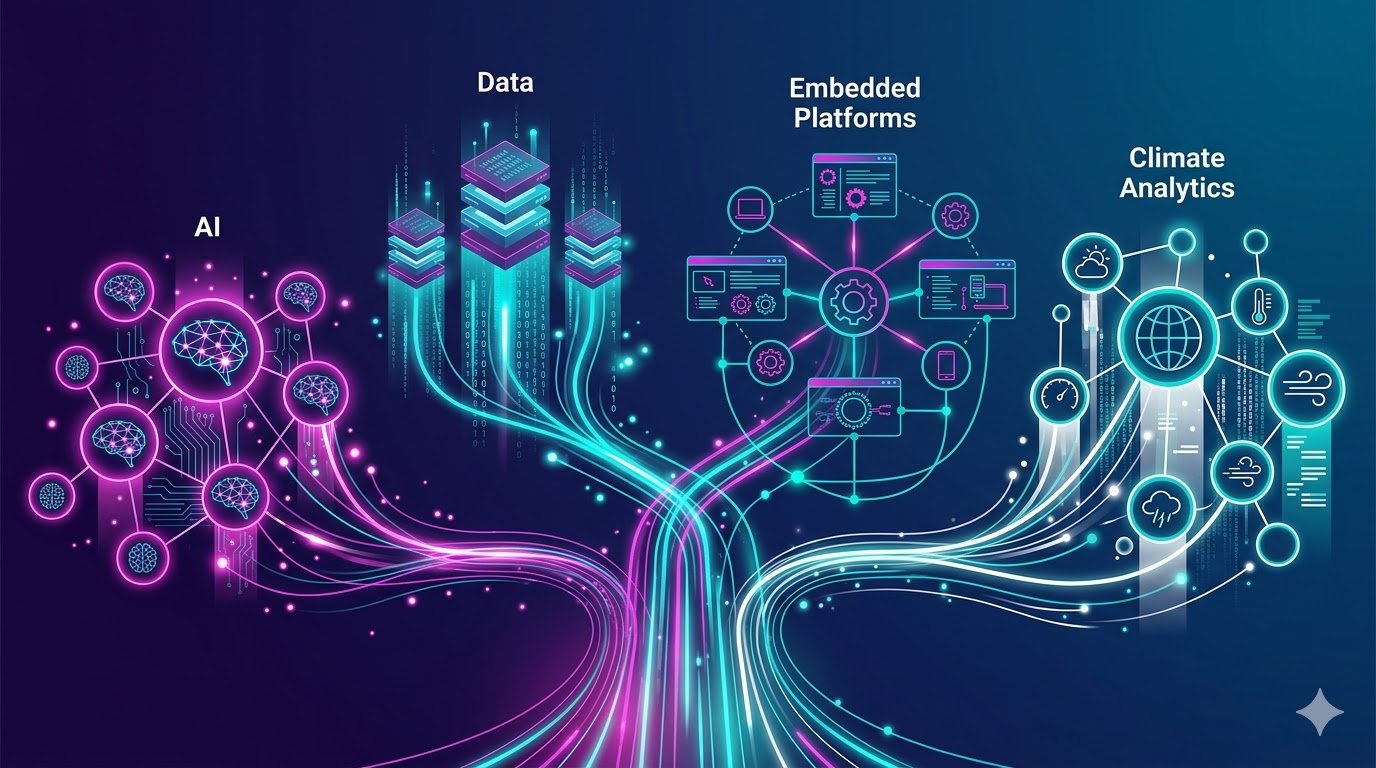
The insurance industry is spending aggressively on artificial intelligence. Forrester projects U.S. insurance technology spending will reach $173 billion in 2026, with AI in insurance growing from $10.24 billion in 2025 to a projected $49.13 billion by 2030. Yet for the majority of carriers, that investment is producing disappointing returns—and the reason has nothing to do with the AI models themselves. The bottleneck is insurance data architecture.
WTW’s March 2026 Advanced Analytics & AI Survey delivers the diagnosis: 42% of P&C insurers report data-related issues—poor quality and limited accessibility—as the number-one barrier to analytics adoption. Only 20% have a well-defined analytics strategy guiding daily operations. Meanwhile, industry analysis indicates that up to 70% of insurers’ IT budgets still go toward maintaining legacy systems, and 41% of insurance CIOs identify those systems as the primary obstacle to technological advancement.
McKinsey’s July 2025 research on AI in insurance reinforces the point: change management represents half the effort required to secure impact from AI transformations. Clean data, modeling, and integration account for the other half. The carriers that fix their data foundation first will scale AI. Those that skip this step will continue cycling through pilots that never reach production. ITT hub article on top 10 insurance technology trends redefining the market in 2026.
The following four upgrades represent the architectural shifts that separate carriers deploying AI at scale from those trapped in pilot mode.
1. Unified Data Platforms Replace Siloed Systems
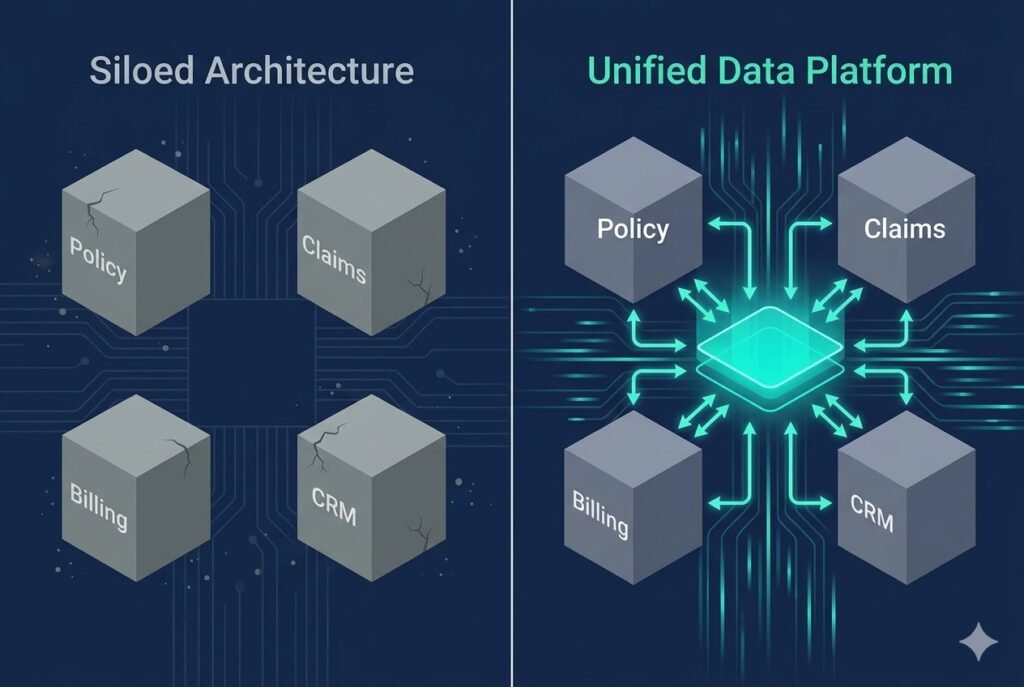
Most insurers operate with policy, claims, billing, and customer service systems that were implemented independently—often across different decades, vendors, and geographies. The result is fragmented data that produces inconsistent reporting, duplicated records, and operational blind spots that make enterprise-wide AI deployment effectively impossible.
Research from Stripe’s data modernization analysis confirms the pattern: data silos remain the foundational barrier, with legacy systems designed for stability and recordkeeping rather than real-time insight. An Insurance Journal analysis from February 2026 describes the challenge as “architectural” at its core—legacy systems were never designed for real-time connectivity, and teams end up relying on manual workarounds and spreadsheets just to maintain daily operations.
The upgrade path is a unified data platform that consolidates structured and unstructured data from internal systems, third-party sources, IoT feeds, and reinsurer data streams into a single queryable layer. This does not necessarily mean ripping out legacy systems. Many carriers are introducing orchestration layers and API wrappers that connect disparate tools and data sources, creating a unified view without the risk of full platform replacement.
The business case is direct. Unified data platforms enable consistent KPIs across business units, faster cross-border analytics, improved regulatory response, and—critically—the clean, accessible data that AI models require to move from prototype to production. Without this foundation, every other AI investment underperforms. Deloitte 2026 Global Insurance Outlook on data readiness.
2. Real-Time Data Pipelines Enable Dynamic Decision-Making
Traditional insurance data architectures operate in batch mode—data is collected, processed overnight, and made available the next business day. That cadence was adequate for an industry built on annual policy cycles and quarterly portfolio reviews. It is inadequate for an industry where agentic AI systems require real-time data to make autonomous underwriting and claims decisions.
The shift to streaming and event-driven architectures enables live data movement that supports immediate risk assessment, dynamic pricing, and continuous portfolio monitoring. Cloudera’s 2026 predictions describe this as the convergence of hybrid infrastructure—where workloads run wherever they make the most sense, guided by policy and governance rather than storage location.
The practical applications are already visible. Carriers deploying real-time pipelines can ingest IoT sensor data from connected vehicles, smart homes, and wearable devices to adjust risk profiles continuously rather than at renewal. Claims systems can receive and process first notice of loss data in real time, automatically triaging and routing cases before an adjuster reviews them. Underwriting platforms can pull third-party data—credit, weather, satellite imagery—at the moment of submission rather than through manual overnight batch processes.
McKinsey’s AI capabilities stack for insurers places the data platform as one of four critical layers, alongside reimagined engagement, AI-powered decision-making, and infrastructure. The data platform layer requires hybrid cloud infrastructure designed for scalability, combined with highly configurable core product processors that provide the flexibility and efficiency that real-time operations demand. ITT article on agentic AI transforming insurance underwriting in 2026.
3. Embedded Data Governance Turns Compliance Into a Competitive Advantage
Data governance in insurance has historically been a compliance exercise—periodic audits, manual data quality checks, and policy documents that sit unread in shared drives. That approach is incompatible with AI deployment at scale, where every automated decision requires traceable data lineage, documented provenance, and auditable access controls.
The regulatory pressure is intensifying. The EU AI Act, effective August 2026, requires insurers using AI in underwriting or claims to maintain detailed records of data used, model development, and decision-making processes. U.S. state regulators are expanding their focus on AI governance and fairness of automated rating factors. Deloitte’s 2026 Outlook warns that many insurers struggle with “fragmented, messy data sprawl” and calls for data readiness to be treated as a strategic priority, not a back-office function.
The upgrade is embedded, policy-driven governance—automated lineage tracking, metadata management, and role-based access controls built into the data platform itself rather than layered on as an afterthought. This means every dataset, whether structured, unstructured, real-time, or model-generated, carries its own semantics, lineage, and guardrails from the moment it enters the system.
The competitive advantage is counterintuitive but well-documented: the carriers with the strongest governance frameworks are deploying AI fastest. Industry analysis shows that seven of the top ten agentic AI adopters scored highest on data governance assessments. Strong governance enables speed because it removes the uncertainty and risk review cycles that slow down every deployment when data quality and provenance are unclear.
4. API-First Integration Architectures Unlock Ecosystem Connectivity
The final architectural upgrade addresses a barrier that limits not just AI deployment but the entire modernization agenda: the inability of legacy systems to connect with external partners, digital channels, and new platforms. Industry data shows that 67% of insurance executives view API strategy as vital for digital transformation and ecosystem integration, and 68% are actively upgrading core systems to cloud-based platforms.
API-first architectures decouple data exchange from monolithic system dependencies. Instead of requiring custom integrations for every new partner, data source, or distribution channel, carriers build standardized API layers that enable plug-and-play connectivity. This is the infrastructure that powers embedded insurance distribution, real-time third-party data enrichment, broker-carrier digital connectivity, and the multi-agent AI systems that require seamless access across policy administration, underwriting workbenches, and external data sources.
McKinsey’s AI capabilities stack emphasizes that reusable, modular components are critical to scaling AI across domains. An AI-powered document classification engine developed for underwriting can also enhance claims processing and policy servicing—but only if the underlying architecture supports interoperability through standardized APIs and coding assets. Without this layer, every AI use case requires bespoke integration work that kills both speed and ROI.
The Send/Camelot underwriting trends report for 2026 reinforces the urgency: in a softening market where brokers are using better technology to target their core markets, carriers that cannot ingest structured broker data at scale through automated API connections risk being viewed as an unnecessary hurdle—losing share to competitors that respond quickly, reliably, and digitally. ITT article on strategies for scaling embedded insurance and omni-channel CX.
The Data Foundation Determines the AI Ceiling
These four upgrades—unified platforms, real-time pipelines, embedded governance, and API-first integration—are not independent projects. They form a cohesive architectural strategy that determines how far and how fast a carrier can scale AI across the enterprise.
The financial stakes are clear. WTW’s survey shows insurers with more sophisticated analytics achieved combined ratios six points lower and premium growth three points higher than slower adopters. McKinsey’s research demonstrates that AI leaders in insurance have generated 6.1 times the total shareholder return of laggards. But those returns flow only to carriers whose insurance data architecture can support AI in production—not just in proof of concept.
The carriers that treat data architecture as the foundation of their AI strategy—not an afterthought to it—will be the ones that capture the $49 billion AI opportunity that Forrester projects for 2030. Those that continue layering AI tools on top of fragmented, siloed, batch-processed data will continue to wonder why their pilots never scale.
Sources: WTW 2026 Advanced Analytics & AI Survey (March 2026); McKinsey “The Future of AI in Insurance” (July 2025); Deloitte 2026 Global Insurance Outlook; Forrester US Insurance Tech Spending 2026; Cloudera 2026 Data Architecture & AI Predictions; CoinLaw Digital Transformation in Insurance Statistics 2026; Stripe Data Modernization in Insurance; Insurance Journal unified data analysis (Feb 2026); Send/Camelot “Top 10 Insurance Trends Shaping Underwriting in 2026.”
