

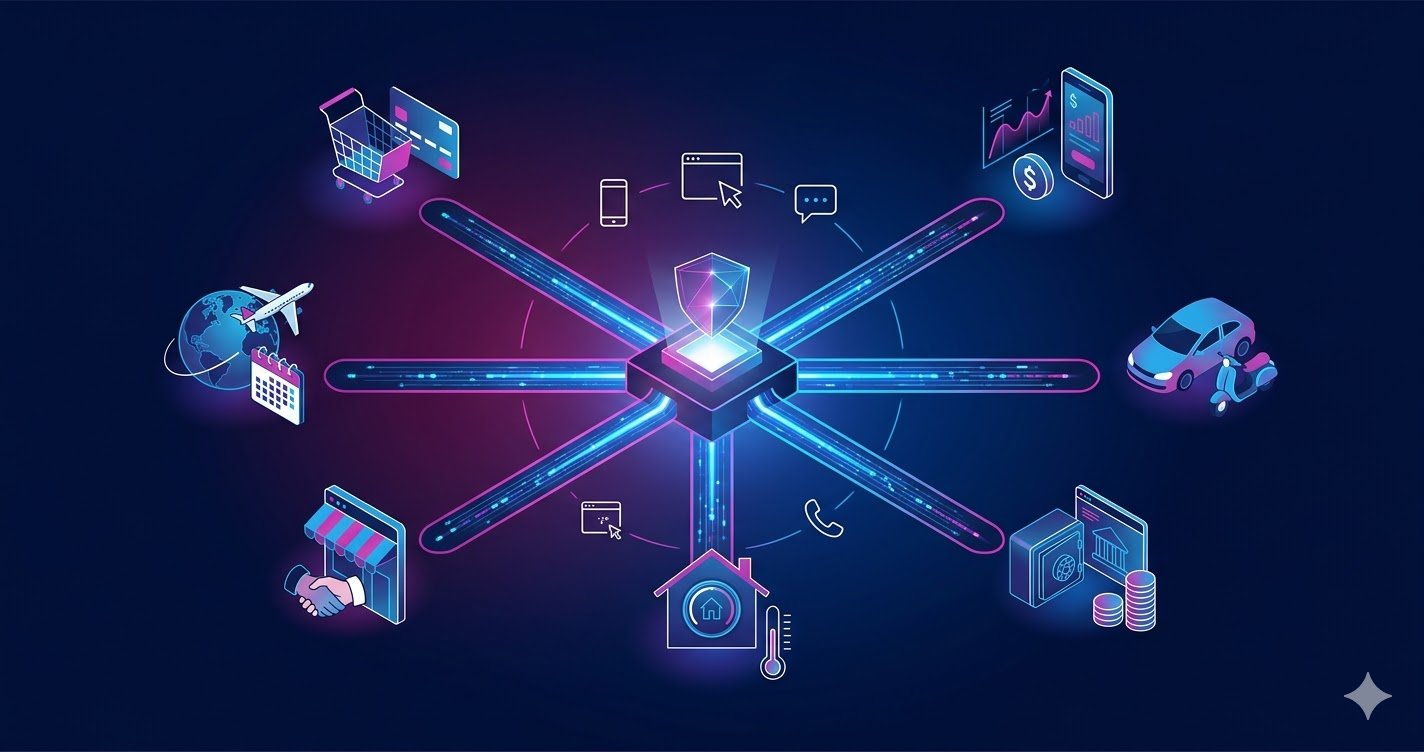
agent, request a quote, and purchase a standalone policy—is giving way to a paradigm where coverage is integrated directly into the purchase journeys customers already take. This is embedded insurance, and in 2026 it has crossed from innovation experiment to strategic imperative. Multiple market research firms project the global embedded insurance market between $176 billion and $189 billion this year, growing at a compound annual rate exceeding 30%.
The consumer signal is unambiguous. According to CX Pilots’ 2026 benchmark report, 47% of auto insurance consumers now purchase policies through digital channels—considerably more than the 35% buying through agents or the 17% using call centers. Capgemini’s World Life Insurance Report 2026 found that 67% of consumers under 40 want digital access paired with dedicated advisor support, yet only 16% of insurers deliver this blended experience. The American Customer Satisfaction Index reports that industry-wide CX scores declined in 2025, driven by premium increases, claims complexity, and broader economic pressure.
The carriers that win in this environment will be those that master both embedded insurance and omnichannel CX simultaneously—seamlessly integrating coverage into partner ecosystems while delivering consistent, personalized experiences across every touchpoint. The following seven strategies represent the playbook for doing so. ITT hub article on top 10 insurance technology trends redefining the market in 2026.
1. Adopt API-First Architecture as the Non-Negotiable Foundation
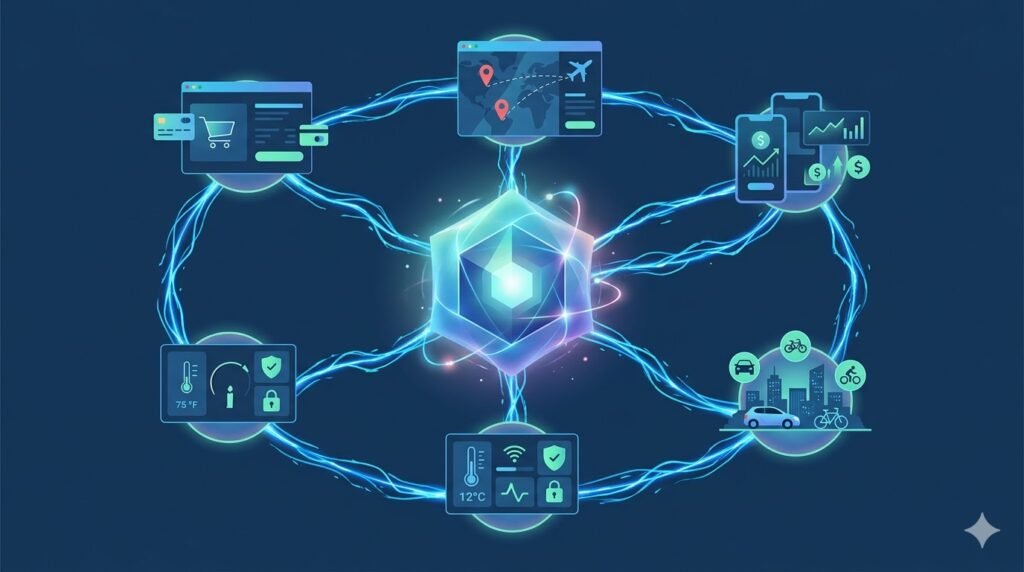
Every strategy on this list depends on one prerequisite: modular, API-first infrastructure that enables plug-and-play connectivity with external partners. Mordor Intelligence’s March 2026 embedded insurance report found that online and API-first placements held 76.38% of market share in 2025—confirming that the distribution channel has already tipped decisively toward digital integration.
API-first architecture decouples insurance product configuration from monolithic core systems. Instead of building bespoke integrations for every distribution partner, carriers create standardized API layers that support real-time policy binding, automated claims reporting, and faster settlement processes. This turns insurance configuration into what industry analysts describe as a “flexible product factory”—enabling rapid iteration and partner-specific tailoring without heavy development cycles.
The practical implication is that carriers still running on legacy policy administration systems without API wrappers face a structural disadvantage in accessing the embedded channel. Every month of delay narrows the window to establish partnerships with the digital platforms where customers are already transacting. TT article on essential data architecture upgrades for scaling insurance AI.
2. Build Ecosystem Partnerships, Not Just Distribution Agreements
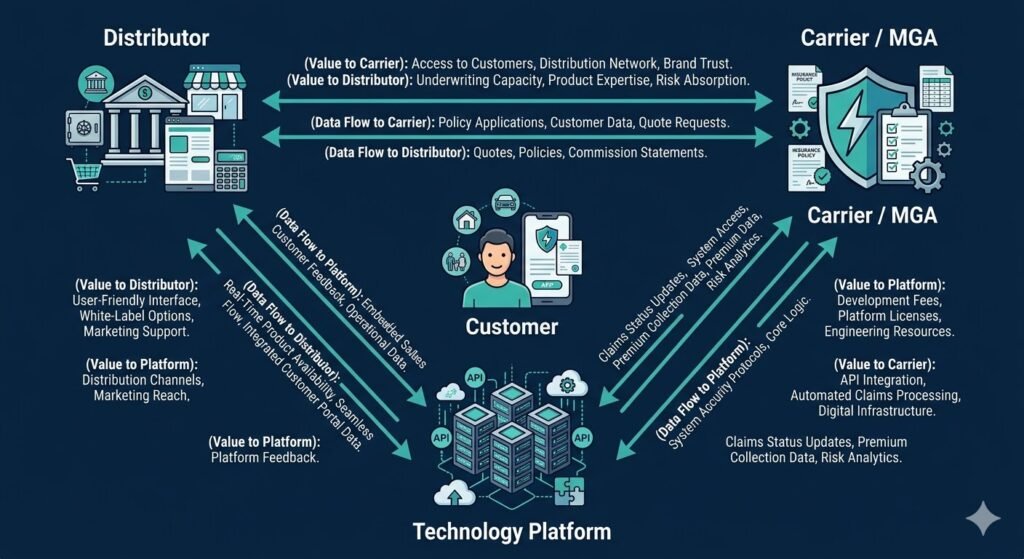
The embedded insurance model requires a fundamentally different partnership structure than traditional distribution. The ecosystem consists of three core players: distributors (banks, retailers, OEMs, digital platforms) who own the customer context; carriers and MGAs who provide risk capacity, compliance, and underwriting expertise; and platform or technology partners who deliver APIs, modular infrastructure, and analytics.
Industry analysis from Qover describes how this works in practice: a neobank uses its customer data and interface, draws underwriting from a carrier, and leverages a technology platform for API infrastructure and claims automation. None of them build the full stack, so each participant captures value from its core competency.
McKinsey projects that by 2030, approximately 25% of all personal lines premiums could be purchased via embedded propositions, representing over $700 billion in gross written premiums in P&C alone. Carriers that approach embedded insurance as a simple distribution agreement—rather than as a three-sided ecosystem play—will capture only a fraction of this opportunity.
3. Deploy AI-Powered Personalization at the Point of Sale
Generic embedded offers underperform. The carriers achieving the highest attach rates are those deploying AI to personalize the insurance offer in real time based on customer context, purchase behavior, and risk profile. Chubb’s November 2025 launch of its AI-Powered Optimization Engine for the Chubb Studio platform exemplifies this approach—using proprietary data to deliver real-time, personalized embedded insurance offers through partner digital channels.
The consumer expectation is clear. Research indicates that 79% of Millennials and Gen Z consumers want auto insurance included directly with vehicle purchases. But they do not want generic, one-size-fits-all coverage. They want offers tailored to their specific risk profile, purchase context, and price sensitivity—delivered seamlessly within the checkout flow.
For carriers, this means embedding AI-driven pricing and product recommendation engines within the API layer, so that when a customer reaches a partner’s checkout page, the insurance offer presented is already calibrated to that individual. The alternative—static offers with fixed pricing—produces low conversion rates and erodes the perceived value of embedded coverage.
4. Own the Full Lifecycle, Not Just the Point of Sale
The most common failure mode in embedded insurance is treating it as a checkout add-on and ignoring the post-purchase experience. Industry analysts note that insurance user experience is becoming inseparable from brand trust—poor insurance experiences now directly impact the distributing platform’s customer loyalty. Claims and servicing can no longer be “someone else’s problem.”
Successful embedded strategies integrate the full lifecycle: from pricing and sale through servicing, communication, and claims. When a customer purchases travel insurance through a booking platform and needs to file a claim, the experience must feel seamless—not like being handed off to a separate, disconnected insurer.
Revenue models are maturing accordingly. Industry analysis shows that platforms are moving beyond commission-only arrangements into profit-sharing and performance-based structures, with distributing partners now accountable for service quality, claims experience, and loss ratios. This alignment of incentives ensures that both the carrier and the platform are invested in the end-to-end customer experience. Read: Capgemini World Life Insurance Report 2026
5. Bridge the Digital-Human Gap With Omnichannel Design
Omnichannel is not a synonym for digital-only. Capgemini’s 2026 research reveals the critical nuance: 67% of consumers under 40 want digital access paired with dedicated advisor support. The carriers winning on CX are those blending AI-enabled efficiency with human oversight—ensuring speed without sacrificing empathy.
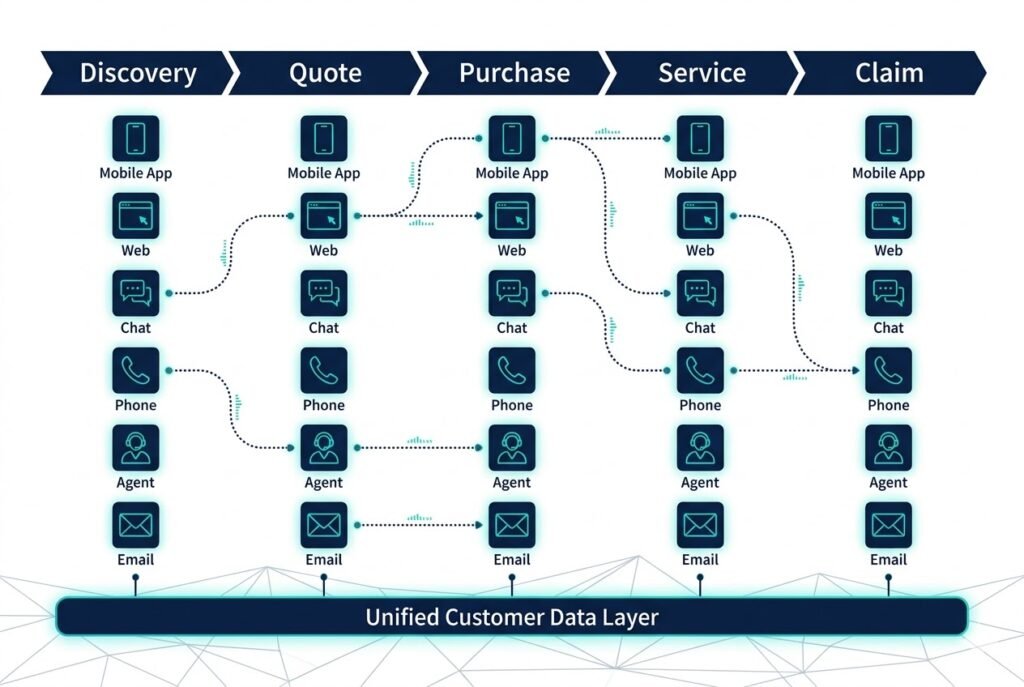
In practice, omnichannel design means a customer can start a quote on a mobile app, ask a question via chat, continue on a desktop, and complete the purchase with an agent—without repeating information at any transition point. It means proactive communication through the channel the customer prefers, whether that is SMS, email, app notification, or a printed document.
The technology enabling this is not exotic. It requires a unified customer data layer that maintains context across channels, a communication orchestration engine that routes messages through the right channel at the right time, and integration between digital self-service tools and human advisor workflows. The carriers that invested in these foundations during 2024–2025 are now converting that infrastructure into measurable retention and satisfaction advantages.
6. Expand From Single Products to Cross-Sell Portfolios
The early phase of embedded insurance focused on single-product offers: travel insurance at booking, device protection at checkout, delivery coverage at purchase. The 2026 evolution is the expansion from single products into broader portfolios that span travel, device, purchase protection, mobility, and SME coverage—turning embedded insurance into a scalable cross-sell engine.
Market data supports the trajectory. The embedded insurance market is expected to grow from approximately $18 billion in 2026 (Mordor Intelligence’s narrower platform-focused definition) to $68 billion by 2031. Broader market estimates from Precedence Research and Fortune Business Insights place the 2026 figure between $176 billion and $189 billion when including all embedded distribution channels. The SME segment is expected to expand at the fastest compound growth rate through 2035, as embedded models make coverage accessible to small businesses that traditional distribution has underserved.
For carriers, the strategic implication is clear: the competitive advantage shifts from having an embedded product to having an embedded platform that can rapidly configure and deploy multiple products across diverse partner channels. Modular product architecture and flexible pricing engines become as important as the products themselves.
7. Measure What Matters: From Attachment Rates to Lifetime Value
The metrics for embedded insurance are maturing. First-generation programs measured attachment rates—what percentage of customers opted in at checkout. While attachment rates remain important, leading programs now track a broader set of performance indicators: customer lifetime value across the embedded portfolio, claims satisfaction scores attributed to the distributing platform, loss ratios by partner channel, renewal and retention rates for embedded policies, and cross-sell conversion from initial embedded purchase to broader coverage.
This measurement evolution reflects the broader maturation of embedded insurance from a tactical add-on to a strategic growth engine. The carriers and platforms that build performance-based partnership models—with shared accountability for these metrics—will outperform those that still treat embedded insurance as an incremental revenue line.
The American Customer Satisfaction Index’s finding that industry-wide CX scores declined in 2025 underscores the urgency. In an environment of rising premiums and increasing claims complexity, the customer experience delivered through embedded and omnichannel touchpoints is becoming the primary differentiator for retention and growth. ITT hub article on insurance technology trends 2026.
The Distribution Model Has Already Shifted
These seven strategies—API-first architecture, ecosystem partnerships, AI personalization, full-lifecycle ownership, omnichannel design, portfolio expansion, and performance measurement—represent the operational playbook for carriers that recognize embedded insurance is not a niche channel. It is becoming the primary way a growing share of consumers encounter and purchase coverage.
McKinsey’s projection that 25% of all personal lines premiums could flow through embedded channels by 2030 is not a distant forecast. The infrastructure decisions, partnership structures, and CX investments that carriers make in 2026 will determine whether they capture share in that $700 billion opportunity—or watch it flow to competitors and platform-native insurers that moved first.
The distribution model has already shifted. The question is whether your organization’s technology, partnerships, and customer experience strategy have shifted with it.
Sources: Capgemini World Life Insurance Report 2026; McKinsey embedded insurance projections (via Deloitte); Mordor Intelligence Embedded Insurance Market Report (March 2026); Precedence Research Embedded Insurance Market 2026; Fortune Business Insights Embedded Insurance Market Analysis; Briisk InsurTech Trends for 2026; Chubb Studio AI
