


The numbers are stark. Swiss Re’s Resilience Index estimates the global climate protection gap—the difference between economic losses from natural catastrophes and the amount covered by insurance—could top $1.8 trillion. In 2025 alone, insured natural catastrophe losses reached $107 billion globally, with total economic losses climbing to $162 billion in just the first half of the year, according to Aon. The gap between what is lost and what is covered is not narrowing. It is widening.
Traditional indemnity insurance—the model that requires damage assessment, claims adjustment, and loss verification before a policyholder receives payment—was not designed for the speed and scale of climate-driven catastrophe. Parametric insurance offers a structural alternative: coverage that pays out automatically when predefined triggers are met, such as wind speed thresholds, rainfall levels, or seismic measurements, without waiting for an adjuster to assess the damage.
The parametric insurance market is estimated at $21–24 billion in 2026, growing at a compound annual rate of approximately 13%, according to multiple market research firms. But the more important story is not the market size—it is the three innovation categories that are expanding parametric coverage beyond its traditional niche in catastrophe reinsurance into mainstream commercial lines, smallholder agriculture, and digital infrastructure. Read: ITT hub article on top 10 insurance technology trends redefining the market in 2026
1. AI-Powered Satellite and Sensor Networks Enable Hyper-Local Trigger Precision
The fundamental challenge of parametric insurance has always been basis risk—the gap between what the trigger measures and what the policyholder actually experiences. A hurricane parametric policy triggered by wind speed at a regional weather station may not accurately reflect the damage at a specific property thirty miles away. This basis risk has historically limited parametric adoption to large-scale catastrophe reinsurance, where the trigger approximation is acceptable given the portfolio scale.
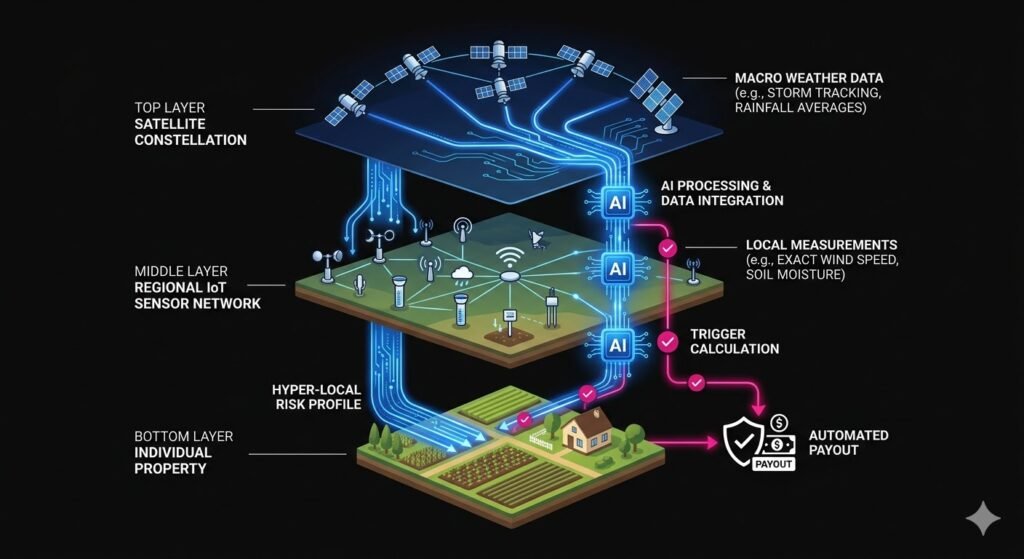
That constraint is dissolving. The convergence of AI, satellite imagery, IoT sensors, and advanced weather modeling is enabling hyper-local trigger design that dramatically reduces basis risk. Machine learning algorithms can now process real-time data from multiple sources—satellites, ground-based weather stations, IoT sensors, and government databases—to create dynamic risk profiles with granular geographic precision.
The real-world applications are already scaling. The Pacific Insurance and Climate Adaptation Programme (PICAP) has deployed 37 parametric products across eight Pacific island nations, including Fiji, Papua New Guinea, Samoa, and Vanuatu, with payouts triggered throughout 2025 for cyclones, excess rainfall, droughts, and earthquakes. Swiss Re’s agricultural parametric platform uses satellite data to monitor crop conditions at the individual farm level, enabling payouts within days of a qualifying weather event rather than the weeks or months required by traditional crop insurance.
Arbol, a climate risk coverage platform, has incorporated AI-driven predictive analytics and real-time weather data from NOAA to automate payouts for specialty crop producers. The system uses machine learning to improve trigger accuracy continuously, reducing false payouts while ensuring legitimate claims are processed without human intervention.
For the 600 million smallholder farmers responsible for approximately one-third of global crop production—a population that traditional insurance has largely failed to reach—this precision is transformative. Parametric products built on satellite and sensor networks can deliver financial protection at a cost and speed that indemnity models cannot match in these markets.
2. Hybrid-Parametric Models Bridge the Gap Between Speed and Accuracy
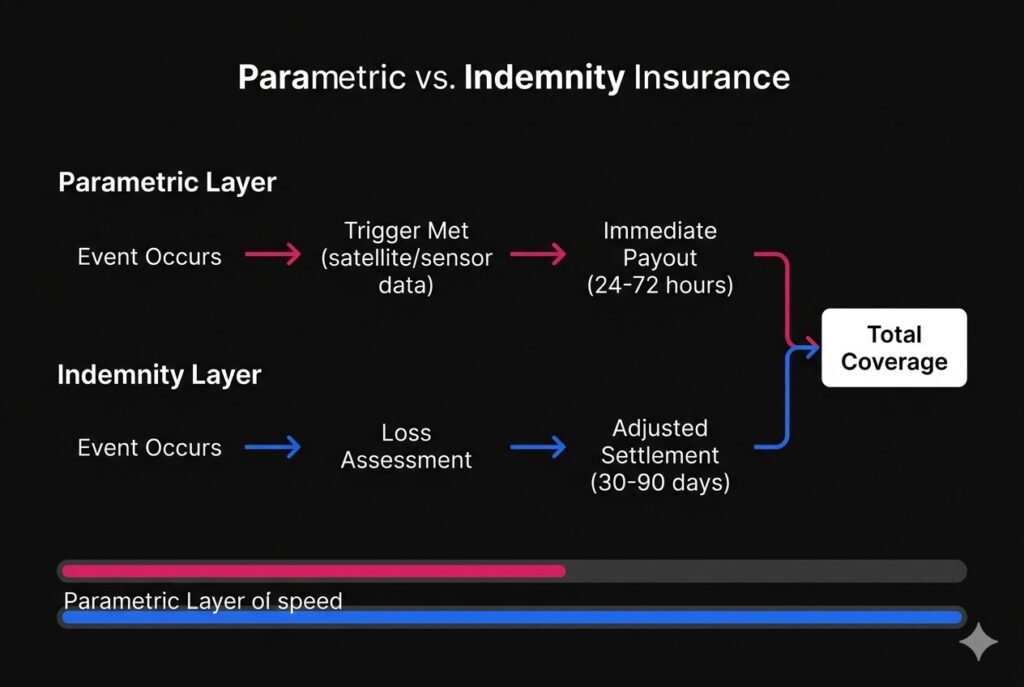
Pure parametric insurance offers speed—payouts within days or even hours of a triggering event. Pure indemnity insurance offers accuracy—payouts calibrated to actual verified losses. For years, these two models existed as separate product categories. The innovation reshaping the market in 2026 is the hybrid-parametric model that combines the advantages of both.
Hybrid-parametric structures layer a fast parametric trigger for an initial payout—providing immediate liquidity when a policyholder needs it most—followed by an indemnity assessment that verifies and adjusts for actual losses incurred. The parametric layer addresses the liquidity crisis that catastrophe victims face in the days immediately following an event, while the indemnity layer ensures the final settlement reflects true economic impact.
Industry analysts at the Insurance Innovators Summit in October 2025 shared how the market is exploring new ways to package traditional attritional loss coverage with parametric triggers into unified products. This is not a theoretical exercise. Ki Insurance now tracks supply chains via GPS to trigger rapid payouts for disruption events—a hybrid approach that combines parametric speed with shipment-specific loss data. Parametrix demonstrated the model’s versatility by paying cloud outage claims within two weeks of an Amazon Web Services incident in October 2025, using service-level agreement data as the parametric trigger while adjusting for documented business interruption.
The strategic significance extends beyond individual products. Hybrid-parametric models address the single largest objection carriers and corporate risk managers have raised against pure parametric insurance: that trigger-based payouts may not align with actual losses. By combining both mechanisms, hybrid structures make parametric coverage viable for a far wider range of commercial risks—from supply chain disruption and business interruption to cyber outages and renewable energy production shortfalls. Swiss Re parametric insurance solutions overview.
3. Blockchain and Smart Contracts Automate the Entire Parametric Value Chain
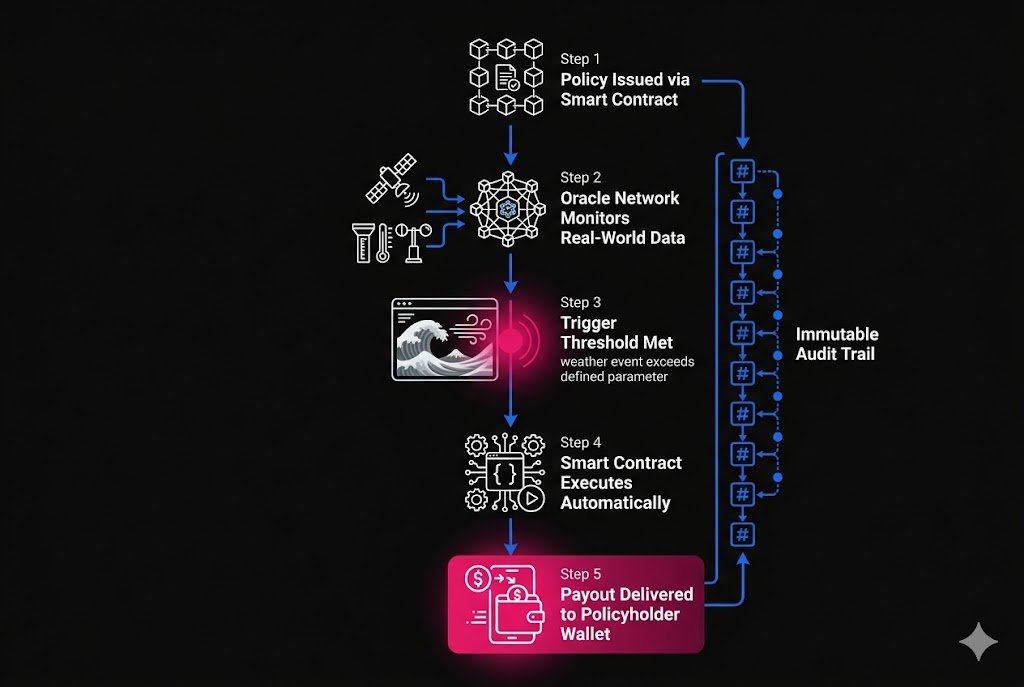
The third innovation is infrastructural: blockchain-based smart contracts that automate every step of the parametric insurance process, from policy issuance through trigger verification to payout execution. Smart contracts are programs stored on a blockchain that execute automatically when predetermined conditions are met—a perfect architectural match for parametric insurance, which operates on the same conditional logic: if a defined event occurs, a defined payment is made.
The technology stack works through oracle networks—decentralized data feeds that connect blockchain smart contracts to real-world data sources. When a satellite weather feed reports rainfall above a defined threshold, or an IoT sensor detects wind speed exceeding a specified level, the oracle delivers that data to the smart contract, which executes the payout without human intervention. The blockchain provides an immutable audit trail of every transaction, reducing fraud risk and increasing transparency for regulators and policyholders alike.
Market data from Market.us values the global smart contracts market at $1.9 billion in 2024, growing at a 25.8% compound annual rate through 2033. Within insurance specifically, natural catastrophe applications accounted for 42.7% of the smart contract insurance market, with blockchain-based contracts holding 55.6% technology share. Corporations represented the largest end-user segment at 48.6%, as enterprises increasingly adopt parametric solutions for climate risk, supply chain disruption, and operational losses.
The practical impact is cost reduction and accessibility. By eliminating claims adjustment, manual verification, and administrative overhead, smart contract-based parametric products can be offered at lower premiums—making coverage economically viable for populations and businesses that traditional insurance has priced out. For underserved markets in developing economies, where a single weather event can devastate a farming community, the combination of mobile-accessible parametric products with blockchain-automated payouts represents what may be the most scalable path to closing the climate protection gap. ITT article on essential data architecture upgrades for scaling insurance AI.
Closing the Gap Is a Choice, Not a Constraint
The global parametric insurance climate protection gap is not a problem without solutions. The three innovations outlined above—AI-powered satellite trigger precision, hybrid-parametric models, and blockchain smart contract automation—represent a technology stack that can deliver faster payouts, broader coverage, and lower costs than traditional indemnity insurance for the categories of risk that are growing fastest.
The G20’s November 2025 Disaster Risk Reduction Working Group explicitly called for a scaling-up of parametric insurance alongside catastrophe bonds and risk pools. The market is projected to grow from approximately $21 billion in 2026 to nearly $39 billion by 2030. The underlying technologies—satellite analytics, IoT sensor networks, AI risk modeling, and blockchain settlement—are all maturing simultaneously, creating a convergence that makes scaled parametric deployment viable for the first time.
As one industry observer noted at the AM Best reinsurance conference, the uninsurable world is not a certainty. It is a choice. The carriers, reinsurers, and insurtechs that deploy these innovations in 2026 will not only capture a growing market—they will redefine the industry’s role from reactive loss payer to proactive resilience builder. The same innovative energy used to insure algorithms must now be turned toward insuring humanity against the climate risks that are already here.
Sources: Swiss Re Institute sigma data & Resilience Index 2024; Aon 1H 2025 Global Catastrophe Report; Send/Camelot “Top 10 Insurance Trends Shaping Underwriting in 2026”; Research and Markets Parametric Insurance Market Report 2026; Precedence Research Parametric Insurance Market; G20 Disaster Risk Reduction Working Group (Nov 2025); PICAP Pacific parametric program; Ki Insurance; Parametrix; AM Best 2026 reinsurance analysis; Arbol climate risk platform; Market.us Smart Contracts Market data; World Economic Forum Global Risks Report 2025.
