

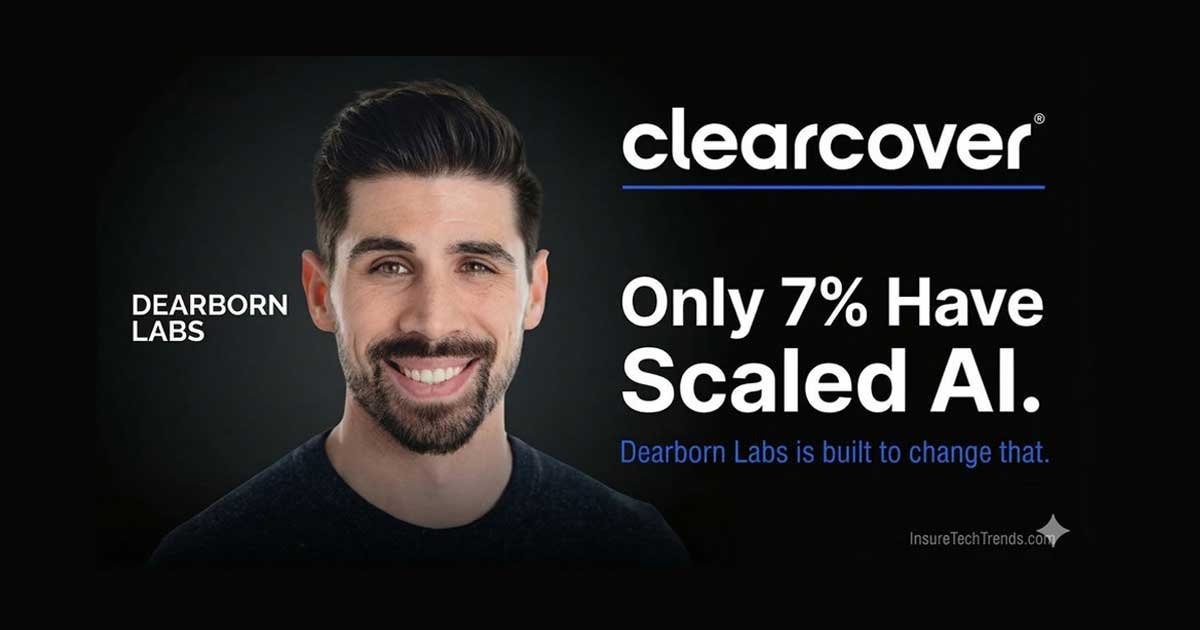
Clearcover, the Chicago-based AI-native auto insurer that has raised more than $560 million to date, is no longer content to keep its AI infrastructure in-house. The company’s founder, Kyle Nakatsuji, has launched Dearborn Labs—a forward-deployed AI practice designed to build and operate production AI systems inside property and casualty carriers and MGAs. The venture, reported by FinTech Global on March 13, represents a deliberate pivot from software licensing to operational embedding: Dearborn Labs places its teams alongside a carrier’s underwriting, claims, and distribution staff, with a commitment to shipping production systems within weeks.
The model has a strong proof-of-concept behind it. At Clearcover, AI now touches nearly every core function. More than 90% of claims intake runs through AI agents, 93% of policies are bound digitally, and the company reports claims handling efficiency at roughly three times the traditional carrier average. Dearborn Labs is built to export that operational blueprint—not as a product, but as an embedded capability.
The Execution Gap Is the Real Problem
Nakatsuji’s thesis is pointed: carriers have already invested in AI. The tools are not what’s missing. What’s missing is the connective tissue—the data architecture and cross-functional integration that allows AI capabilities to compound across departments rather than languish as isolated pilots.
Industry data backs this up. A 2025 report from Roots found that while more than 90% of insurers were exploring or testing AI, only 22% had fully deployed solutions in production. Microsoft research paints an even starker picture, finding that just 7% of insurers have successfully scaled AI initiatives across their organizations. The gap between experimentation and execution is not a technology problem—it is an operations problem. And that is precisely the gap Dearborn Labs is designed to close.
Why Embedded Teams, Not Software?
The model is deliberately positioned against traditional SaaS vendors. Where a software platform delivers a tool and a strategy deck, Dearborn Labs deploys people who work inside the carrier’s operation. As Nakatsuji put it, the firm does not hand over a strategy deck—it deploys into the operation and ships production systems in weeks.
This is a meaningful distinction. Most carriers struggle with AI not because the technology is inadequate, but because their organizational structures, data pipelines, and workflow integrations are not designed for it. A SaaS platform can automate a single function—say, claims triage or document intake—but it cannot rewire how claims data feeds underwriting models, or how underwriting context shapes distribution strategy. Dearborn Labs’ pitch is that those cross-functional connections are where the real returns live.
The concept echoes a broader industry shift. Analysts project that by late 2026, more than 35% of insurers will deploy AI agents across at least three core functions. But deployment alone does not guarantee compounding returns. The winners will be carriers that treat AI as infrastructure—integrated across the enterprise—not as a collection of point solutions.
What This Means for the Market
For carriers and MGAs: Dearborn Labs offers an alternative to the build-versus-buy dilemma. Instead of licensing software or staffing an internal AI team from scratch, carriers can bring in a team that has already solved these problems at production scale. The firm is currently accepting a limited number of engagements for Q2 2026—a deliberate scarcity signal that suggests Nakatsuji is prioritizing depth of engagement over breadth of client acquisition.
For InsurTech vendors: This is a competitive challenge worth watching. If carriers begin favoring embedded AI concierge models over traditional SaaS contracts, the implications for recurring-revenue software businesses in the insurance space are significant. Vendors that cannot demonstrate system-level integration—not just feature-level automation—may find their value proposition under pressure.
For investors: Dearborn Labs signals a maturation of the InsurTech market. The “sell AI tools to carriers” thesis is giving way to a more operationally intensive model. Clearcover’s $1 billion valuation (as of its 2021 Series D) was built on its direct-to-consumer auto business. If Dearborn Labs can monetize the company’s operational AI infrastructure as a B2B service, it opens a second revenue engine that diversifies the holding company’s business model considerably.
What to Watch Next
The critical question is scalability. Clearcover built its AI infrastructure for a single carrier operating in a controlled environment. Translating that to carriers with decades of legacy systems, fragmented data architectures, and deeply entrenched operational workflows is a fundamentally different challenge. Nakatsuji’s team will need to demonstrate that the embedded model works across varying levels of technological maturity—not just at digital-native companies.
Watch for early engagement results in Q3 and Q4 2026. If Dearborn Labs can show measurable efficiency gains at traditional carriers within the promised weeks-not-months timeline, it could validate a new category: the AI concierge for insurance operations. If it cannot, it becomes another consulting play with a good narrative.
The insurance industry’s AI spending is expected to grow by more than 25% in 2026. The question is no longer whether carriers will deploy AI. It is whether they can make it compound across their operations. Dearborn Labs is betting the answer requires people on the ground, not just software in the cloud.
Source: FinTech Global, “Dearborn Labs launched to embed AI across insurance operations”
