

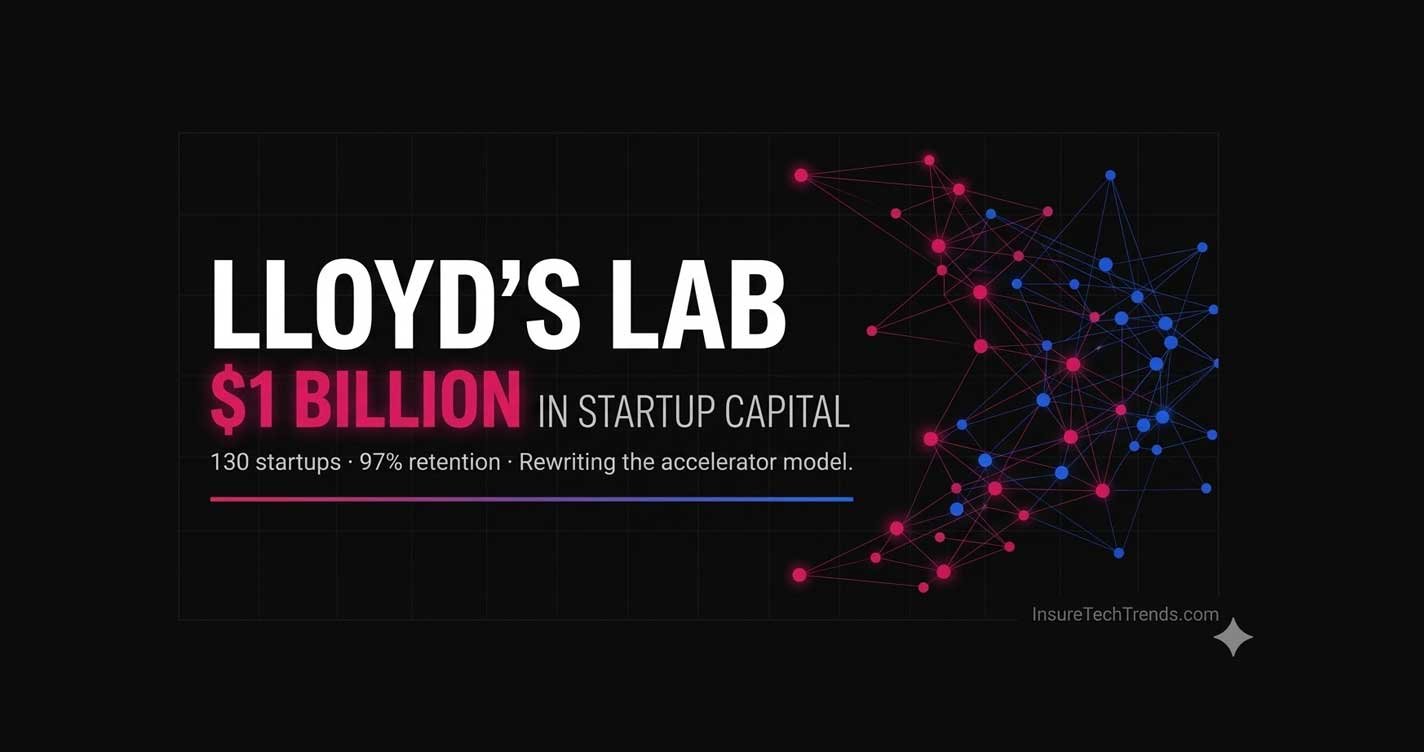
Lloyd’s Lab has quietly become the most consequential accelerator in insurance. Six years and 130 startups in, the program has helped its portfolio companies raise more than $1 billion in capital — a milestone that tells a bigger story about where insurance innovation actually happens and why the industry’s traditional R&D playbook is failing.
Reported from an interview with Dawn Miller, Lloyd’s Chief Commercial Officer and CEO of Lloyd’s Americas, the retention numbers alone are striking: 97% of Lloyd’s Lab alumni are still active in the insurance sector, and over 85% remain embedded within the Lloyd’s ecosystem. Those aren’t incubator vanity metrics. That’s a talent and IP pipeline that most carriers would struggle to replicate internally.
Why It Matters: The Innovation Silo Problem Is Real
The $1 billion number is impressive, but the structural insight behind it matters more. Insurance has a well-documented innovation problem — not a lack of ideas, but a lack of integration. Corporate innovation labs spin up, generate prototypes, and then stall when they hit the underwriting floor.
Miller made this point directly: innovation cannot be something on the side. It has to be integrated into your business. That’s a sharper critique than it sounds. When fintech and healthtech accelerators launched in the 2010s, many produced startups that never found a path to market within their host industries. Lloyd’s Lab avoided that trap by embedding startups directly into the marketplace — sitting them alongside underwriters, brokers, and claims professionals during their 10-week cohort cycle.
The result is startups that build for adoption, not for demo day. When 85% of your alumni are still doing business within the same ecosystem years later, that’s not networking — that’s structural integration.
What Lloyd’s Lab Startups Are Actually Building
The portfolio spans the risk lifecycle. According to Miller, standout verticals include flood risk mapping and prediction tools, AI-driven cyber risk assessment platforms, wildfire modeling systems, and claims processing automation. The common thread: better data inputs that translate directly into better pricing and risk selection.
This is where Lloyd’s data advantage becomes relevant. The marketplace collects thousands of underwriting data points annually across over 200 jurisdictions. The stated ambition is to transform that data into benchmarking and decision-support tools — a layer that could compound the value of every startup building on top of the Lloyd’s platform.
For investors watching the InsurTech funding cycle, this is significant. The capital flowing into Lloyd’s Lab companies isn’t speculative seed money chasing consumer distribution. It’s growth capital backing startups that already have distribution through the world’s largest specialty insurance marketplace. That changes the risk profile entirely.
INTERNAL LINK: ITT article on InsurTech funding trends Q1 2026
The Accelerator Advantage: Why Embedded Beats Independent
Compare Lloyd’s Lab to the broader InsurTech accelerator landscape and the differentiation is clear. Most programs offer mentorship, pitch sessions, and a demo day. Lloyd’s Lab offers something harder to replicate: a live marketplace with real buyers, real risk, and real regulatory infrastructure across 200 jurisdictions.
Miller described the licensing framework as a strategic asset. Startups entering the Lloyd’s network gain access to a global operating license without the administrative overhead of establishing local policies jurisdiction by jurisdiction. For a startup that needs a multinational footprint to prove its model, that’s not a nice-to-have — it’s a moat.
The program has also expanded beyond its original cohort model. Lloyd’s now operates FutureMinds (a talent pipeline), the Lloyd’s Lab Challenge (targeted problem-solving sprints), and a Launchpad Network that extends the alumni community into a permanent industry resource. The “Dragon’s Den” pitch events Miller referenced aren’t theater — they connect startups directly to Lloyd’s Central Fund and external capital partners.
INTERNAL LINK: ITT article on accelerator models in InsurTech
The Bigger Commercial Play: Innovation as Strategy, Not Branding
Lloyd’s is now entering year three of its broader commercial strategy, and innovation sits as one of its named pillars — not as a corporate social responsibility initiative or a PR exercise. That distinction matters. When the accelerator outputs feed directly into platform modernization and underwriting guideline updates, innovation moves from cost center to competitive infrastructure.
The commercial context is equally important. Miller pointed to expanding demand for wholesale insurance in underserved markets across Europe, Africa, and Asia, where natural disaster risks are escalating while government budgets for catastrophe response are tightening. The private sector is being asked to fill a protection gap that public balance sheets can no longer cover.
For carriers and MGAs evaluating their own innovation strategies, the Lloyd’s Lab model offers a clear takeaway: the most productive innovation programs are the ones closest to the underwriting decision. Standalone labs produce interesting technology. Embedded accelerators produce revenue.
EXTERNAL LINK: Lloyd’s Lab official program page
What’s Next
Watch for Lloyd’s to push harder on data-as-a-service for its accelerator alumni. The combination of marketplace-wide underwriting data and startup-built analytics tools points toward a platform play that could reshape how specialty risk is priced globally. If Lloyd’s Lab’s next cohort cycle produces the benchmarking infrastructure Miller hinted at, the accelerator stops being a program and starts being a competitive weapon. The $1 billion milestone is the headline. The real story is what gets built on top of it.
