

Peter Zaffino did not expect it to work this fast.
The CEO of AIG spent most of 2024 describing the company’s AI ambitions in terms his investor relations team would have called aspirational. Then the results started coming in. By Q4 2025, Zaffino told analysts that AIG was seeing what he described as “a massive change in our ability to process a submission flow without additional human capital resources. That has been the biggest surprise.”
The surprise was not the AI. It was the layer connecting the AI.
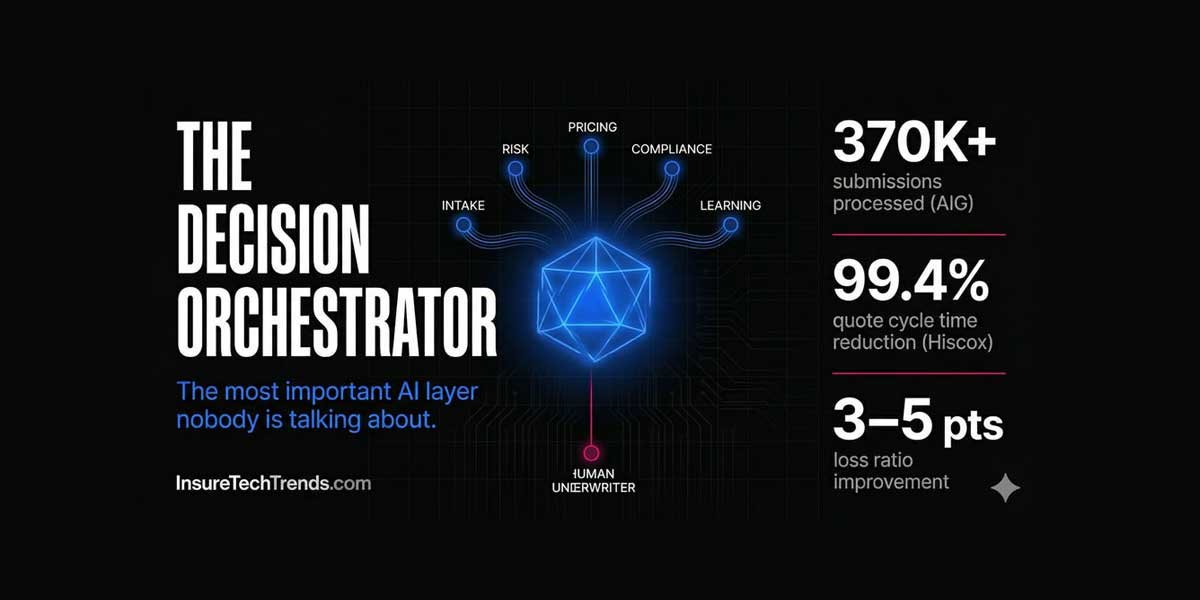
AIG built what it calls an orchestration layer in its technology stack — a coordination system designed to sequence AI agents, manage handoffs between them, and determine when a human underwriter needs to step in. The result: Lexington Insurance, AIG’s E&S unit, surpassed 370,000 submissions in 2025 against a 2030 target of 500,000. They are not just ahead of schedule. They are ahead by a factor that suggests the target was set before anyone understood what the orchestration layer would actually do.
AIG is not alone. But they are one of the few carriers willing to describe publicly what they built — and the description matters because it names something the insurance AI conversation has been circling without landing on: the decision orchestrator is not a feature. It is the infrastructure.
WHO IS BUILDING IT — AND WHO IS STILL BUYING POINT SOLUTIONS IS
Most AI underwriting coverage focuses on the individual agents: the tool that reads the submission PDF, the model that scores the risk, the engine that generates a quote. These are the visible parts of the system — the ones that show up in vendor demos and conference presentations. The orchestrator is what makes them function as a system rather than a collection of expensive point solutions.
McKinsey’s insurance AI research describes it precisely: a decision orchestrator agent aggregates input from various other agents to determine if a policy can be automatically approved or if it needs to be escalated to a human senior underwriter, given the size of the policy or other factors. That description is technically accurate but understates the strategic importance of what that coordination layer actually does.
Here is the complete architecture of an agentic underwriting system, and where the orchestrator sits within it:
|
📄 Intake Agent
|
Reads and extracts from unstructured submissions
PDFs, emails, ACORD forms, spreadsheets — converted to structured data. Communicates with brokers to resolve missing fields. No underwriter involvement for standard submissions.
|
|
📊 Risk Profiling Agent
|
Scores the submission against historical loss data
Pulls third-party signals — property data, credit, telematics, geospatial. Applies ML models. Builds a comprehensive risk profile against underwriting guidelines.
|
|
💲 Pricing Agent
|
Structures the policy and prices the risk
Applies carrier rate models. Accounts for portfolio concentration. Flags market conditions. Outputs a bindable quote or a range with confidence intervals.
|
|
✓ Compliance Agent
|
Reviews the process for regulatory adherence
State-by-state rules. Policy form requirements. NAIC Model Bulletin compliance. Colorado ECDIS requirements. Flags any filing conflicts before the quote is issued.
|
|
◎ Learning Agent
|
Feeds every outcome back into the models
Every bind, decline, and loss becomes training data. Tracks which submission patterns correlate with which loss outcomes. The system improves with every decision.
|
The orchestrator is not the most technically complex component in this architecture. The risk profiling model is harder to build. The compliance agent covers more regulatory surface area. But the orchestrator is the most strategically important — because it is the only component that cannot be purchased off the shelf and dropped into a carrier’s environment.
The reason is simple: the orchestrator encodes the carrier. Its routing logic reflects their risk appetite, their loss experience, their appetite for specific lines and geographies, their broker relationship history, their tolerance for straight-through processing versus human review. A document ingestion API works the same way for every carrier that buys it. The orchestration logic is specific to one carrier — and it gets more specific, more accurate, and more valuable with every decision it processes.
“The individual AI agents are becoming table stakes. The orchestration logic that coordinates them is not — because it is trained on data that belongs to one carrier and no one else.” — InsureTechTrends
WHO IS BUILDING IT — AND WHO IS STILL BUYING POINT SOLUTIONS
The carriers that have moved from pilot to production on agentic underwriting share a common trait: they built the orchestration layer before they bought the agents. The carriers that are struggling share a different common trait: they bought the agents first and are now trying to figure out how to make them work together. The architectural sequence matters enormously.
Here is what production-grade orchestration looks like in practice:
|
AIG / Lexington Insurance
370K+ submissions in 2025
|
Built a proprietary orchestration layer to coordinate AI agents across commercial lines. CEO described it as producing capabilities “much greater” than originally projected. Submission processing capacity increased without additional human capital. E&S unit on track to hit 500K submissions ahead of a 2030 target. |
|
Hiscox
99.4% reduction in quote cycle time
|
London Market specialty lines compressed from three days to approximately three minutes. Not an intake agent doing the work — a coordinated workflow where intake, risk profiling, pricing, and compliance run in sequence with defined handoffs. The orchestration is what makes the speed sustainable without sacrificing accuracy. |
|
Aviva (via hyperexponential)
GCS deployed in production
|
Aviva’s Global Corporate & Specialty unit deployed hyperexponential’s full stack — including Triage, Underwriting Agent, and Portfolio Intelligence — across its commercial book. A tier-1 carrier running agentic orchestration on complex specialty lines, not personal auto. The proof that orchestration works above the simple-risk threshold. |
THE UNDERWRITING WORKBENCH: WHERE THE ORCHESTRATOR LIVES
There is a concept adjacent to the decision orchestrator that practitioners use more often than vendors do: the underwriting workbench. It is the unified environment — part technology platform, part workflow design — where the underwriter interacts with all of the AI outputs simultaneously. The workbench is the surface. The orchestrator is what populates it.
The distinction matters because it clarifies what carriers are actually building when they invest in AI underwriting. They are not building a faster risk scoring tool. They are building a coordinated decision environment — one where the underwriter arrives at a submission and finds the intake already done, the risk profile already built, the compliance check already run, and a bindable quote already structured, with every agent’s confidence level visible and the orchestrator’s routing recommendation ready for review or override.
The underwriter’s job in this environment is not to do the work the agents did. It is to exercise judgment on the cases the orchestrator could not resolve with sufficient confidence — which are, by definition, the most complex, the most novel, and the most consequential risks in the portfolio. The craft does not disappear. It concentrates.
WHY THE ORCHESTRATOR IS THE MOAT — NOT THE MODEL
Insurance executives evaluating AI vendors are asking the wrong question when they ask which model is most accurate. The accuracy question matters — but it is answerable, and the answer is converging. The vendors building risk scoring models are all training on increasingly similar data sources, improving at similar rates, and producing increasingly similar outputs. Within three years, the difference between the best and second-best risk scoring model on a standard commercial lines submission will be marginal.
The orchestration logic is a different story. It is not converging. It is diverging — because it is trained on data that is unique to each carrier and that becomes more specific over time, not less. A carrier that has run 500,000 submissions through its orchestration layer has encoded half a million decisions into its routing logic: which risk profiles its underwriters actually bind, which ones they reprice, which patterns correlate with adverse loss outcomes, which broker submissions tend to arrive clean versus which require follow-up. That institutional knowledge does not exist anywhere else. No vendor can replicate it. No competitor can purchase it.
“The competitive gap in AI underwriting is not opening between the carriers with the best models and the carriers with worse models. It is opening between the carriers that have built orchestration infrastructure and the carriers that are still running point solutions in parallel.”— Corey Wick, InsureTechTrends
This is the insight that growth equity investors with board-level visibility into insurtech companies have named clearly: the data moat in AI underwriting is not the training data that goes into the risk model. It is the decisioning history that gets encoded into the orchestration layer. Gradient AI’s $300 million in verified claims savings is a product of the models — but the compound learning from every decision processed is what makes the platform increasingly difficult to replace. ZestyAI’s 80-plus regulatory approvals create switching costs not because the approvals are valuable in themselves, but because every carrier that has integrated ZestyAI’s risk signals into their orchestration logic now has to reconstruct that integration if they switch.
The orchestrator is where data advantages compound. It is where carrier-specific institutional knowledge gets encoded into software. And it is where the competitive moat in AI underwriting actually forms — not at the model layer, where the vendors compete, but at the coordination layer, where the carriers differentiate.
THE QUESTION NOBODY HAS ANSWERED: WHO IS RESPONSIBLE WHEN IT’S WRONG
The decision orchestrator creates a governance problem that the industry has not yet resolved and that regulators are beginning to notice.
When an orchestrator routes a submission to auto-bind and the bound risk subsequently generates a large loss, the accountability chain is not clear. The carrier deployed the system. The vendor built the orchestration layer. The risk model scored the submission. The training data shaped the model. The learning agent updated the routing logic based on prior decisions. Each of those parties contributed to the outcome. None of them bears clear liability under existing frameworks.
This is not hypothetical. An insurer that deploys an AI agent to automatically issue certificates of insurance and has a data synchronization error produce a COI with incorrect limits — issued without human review — faces a coverage dispute when a loss occurs. The error is in the orchestration logic, not the underlying model. But the legal exposure lands on the carrier, whose E&O policy was written before autonomous underwriting decisioning existed.
THE REGULATORY TRAJECTORY
The NAIC AI working group is examining how insurers apply algorithms in pricing and claims handling. Colorado’s ECDIS regulation, effective October 2025, requires specific documentation standards for AI-assisted underwriting decisions. New York’s NYDFS requires anti-discrimination testing. California DOI is advancing model transparency requirements. The direction is clear: every AI-assisted underwriting decision needs a documented reason code, a model version log, and a defined human escalation path — not as a compliance afterthought, but as a prerequisite for operating the system at all. Carriers building orchestration infrastructure without embedded governance are building toward a compliance collision.
The carriers that emerge from the next three years in the strongest position will be those that treated governance design as part of the orchestration architecture — not a layer added afterward. Auditability is not a feature. For an orchestrator managing thousands of underwriting decisions per day, it is the condition under which the system is allowed to operate.
THE SO WHAT — FOR CARRIERS, VENDORS, AND INVESTORS
The decision orchestrator is not coming. It is here, deployed in production at carriers large enough to build it internally and sophisticated enough to understand what they were building. The question for the rest of the market is not whether to build one — it is how long the delay before competitive pressure makes the decision for you.
For carriers: the orchestration layer is the most important technology investment you will make in underwriting this decade. Not a risk model. Not a document ingestion tool. The coordination layer that makes all of your other AI investments function as a system rather than a collection of expensive parallel experiments. The architectural sequence matters: build the orchestration framework first, then add agents to it. Buying agents first and trying to orchestrate them afterward is how you end up in pilot purgatory.
For vendors: the point solution market is narrowing. The carriers that have built or bought orchestration infrastructure are now evaluating new tools on one primary criterion — how easily does this integrate into our existing coordination layer? Vendors that position themselves as orchestration-native, or that design specifically for integration into carrier-controlled orchestration frameworks, will have longer and stickier commercial relationships than those selling standalone AI capabilities.
For investors: the orchestration layer is where the durable value in AI underwriting concentrates. Not the model vendors, whose competitive advantage converges over time, but the platforms that own the coordination logic — and the data that makes it smarter. The carriers and platforms that compound the most decisioning history through their orchestration infrastructure over the next three years will be the ones that are most difficult to displace in 2030.
AIG saw it faster than their own projections suggested they would. The carriers watching from the sidelines are watching a gap open.
InsureTechTrends.com · Intelligence That Moves Markets · April 2026
